Media/News
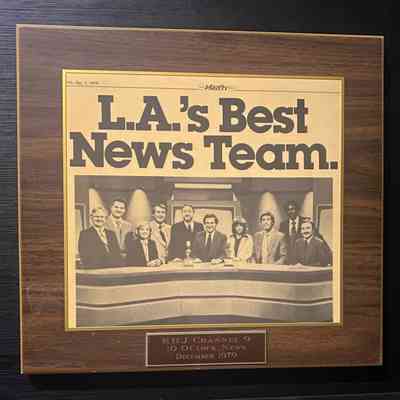
1979 KHJ Channel 9 Variety Magazine Award plaque
A rare 1979 KHJ Variety Magazine Award plaque for being L.A.’s Best News Team; presented to the KHJ Channel 9 10 o’clock news.
The first documented black anchor on the station came a year later—Felicia Jeter, who anchored the 10 o’clock news.
The diversity of the KHJ Channel 9 news team today (now known as CBS News Los Angeles) is represented in the team photo taken at a recent Taste of Soul event in the heart of Los Angeles, which the station helped sponsor.
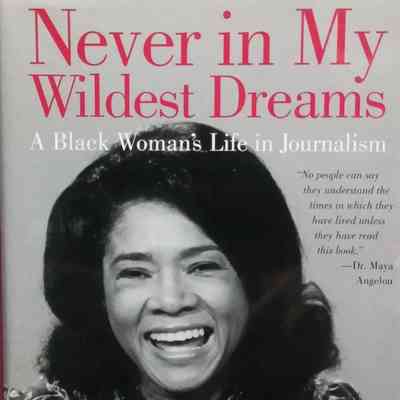
Belva Davis signed “Never in My Wildest Dreams: A Black Woman’s Life in Journalism”
Lousiana native Belva Davis was the first black woman to be hired as a television journalist on the West Coast. She also did radio.
During an interview, she recalled the treatment she and others, including her radio news director, Louis Freeman, received while covering the convention at San Francisco’s Cow Palace, where Barry Goldwater was nominated for president. They were denied press passes. “We were in the rafters, sitting quietly, trying to make sure nobody found us,” she recalled. When Davis and Freeman were discovered, convention attendees yelled, “‘What are you n-ggers doing in here anyway?’,” Davis recalled. “We were driven out of that hall as people threw debris at my news director and I.” (KQED)
From her book “Never in My Wildest Dreams: A Black Woman’s Life in Journalism”:
I could feel the hair rising on the back of my neck as I looked into faces turned scarlet and sweaty by heat and hostility. Louis, in suit and tie and perpetually dignified, turned to me and said with all the nonchalance he could muster, “Well, I think that’s enough for today.”
Methodically we began wrapping up the cords to our bulky tape recorder and packing it and the rest of our equipment into suitcases. As we began our descent down the ramps of the Cow Palace, a self-appointed posse dangled over the railings, taunting. “N-ggers!” “Get out of here, boy!” “You too, n-gger b-tch.” “Go on, get out!” “I’m gonna k-ll your ass.”
I stared straight ahead, putting one foot in front of the other like a soldier who would not be deterred from a mission. The throng began tossing garbage at us: wadded up convention programs, mustard-soaked hot dogs, half-eaten Snickers bars. My goal was to appear deceptively serene, mastering the mask of dispassion I had perfected since childhood to steel myself against any insults the outside world hurled my way. Then a glass soda bottle whizzed within inches of my skull. I heard it whack against the concrete and shatter. I didn’t look back, but I glanced sideways at Louis and felt my lower lip begin to quiver. He was determined we would give our tormentors no satisfaction.
“If you start to cry,” he muttered, “I’ll break your leg.”
This happened just over 60 years ago.
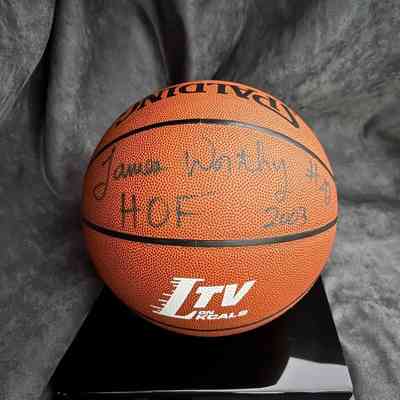
Broadcaster & L.A. Lakers star James Worthy
This piece captures KCAL broadcasting and Lakers history in a single piece—a special “LTV on KCAL 9” branded James Worthy autographed basketball. “Big Game James” moved from being an on court Lakers legend on KCAL to the KCAL broadcasting studio. In the beginning, the transition was not as seamless as his patented Worthy finger roll, as he reminisced in an interview with his former LTV running mate Jaime Maggio:
“I started working on the Paramont lot with Pat Harvey…that’s where I learned my trade. At the beginning I sucked—terrible. I had nothing but a name and I was a former Laker. And thank God guys like Scott Henry, who were patient with me while I learned the trade. That’s where the rubber met the road over there at LTV/KCAL-9/CBS. That’s where I learned how to do it.”
A consummate leader on the court, Worthy made the on court to on air transition before the era of athlete led podcasts.
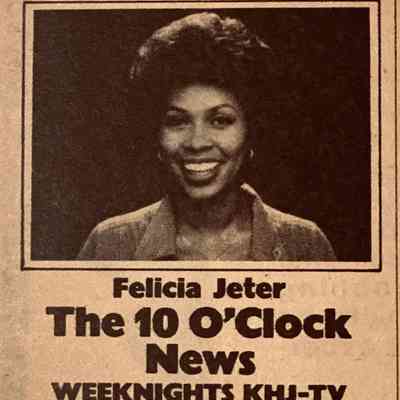
Felicia Jeter
Felicia Jeter is a pioneering television journalist who served as the weeknight anchor for KHJ-TV (Channel 9) in Los Angeles from 1980 through 1981. Anchoring the station’s 10 O’Clock News, Jeter holds the distinction of being the earliest documented black journalist to serve as a news anchor at KHJ-TV, marking an important milestone in the history of Los Angeles television broadcasting.
Before joining KHJ-TV, Jeter worked at KNBC, where she became a weeknight news anchor in the late 1970s. She subsequently continued her broadcasting career with CBS News Nightwatch and KHOU-TV in Houston.
The Historic Artifact
This original advertising clipping promotes Jeter’s new role at KHJ-TV under the headline, “Another Pro Joins an Emmy Winner!” Featuring her photograph and showing her as the station’s 10 O’Clock News anchor, the advertisement documents her position in Los Angeles television journalism during the early 1980s.
More than a promotional advertisement, this original piece preserves a visual record of a pioneering black journalist and an important chapter in the history of racial representation in Los Angeles television news.
Trivia
Jeter appeared as herself in a two-part CHiPs episode in December 1980 titled “The Great 5K Star Race and Boulder Wrap Party.”
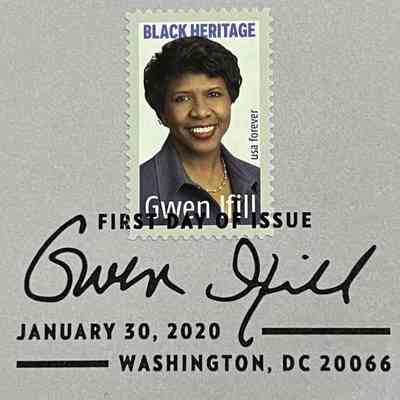
Gwen Ifill First Day of Issue Cancellation Page
This rare 2020 Gwen Ifill First Day of Issue Cancellation Page commemorates pioneering journalist Gwen Ifill (1955–2016), featuring her official U.S. Postal Service Black Heritage Forever stamp, issued January 30, 2020, in Washington, D.C. It is estimated that only a few thousand of these were produced. In contrast, the Post Office printed 40 million Gwen Ifill Forever stamps in 2020.
Ifill broke racial and gender barriers throughout her distinguished career at The Washington Post, The New York Times, NBC News and PBS, becoming the first woman and first African American to moderate a major television news-analysis program. The stamp cancellation page includes her biography, stamp specifications and official first-day-of-issue postmark bearing her signature. It serves as a commemorative tribute to one of America’s most respected journalists and an important figure in African American journalism history.
From the Gwen Ifill First Day of Issue Cancellation Page:
Among the first African Americans to hold prominent positions in both broadcast and print journalism, she was a trailblazer in the profession.
Ifill worked at the Boston Herald-American, the Baltimore Evening Sun, the Washington Post, and the New York Times, before taking a broadcast job at NBC in 1994. Five years later, she joined PBS, where she was the senior political correspondent for The NewsHour with Jim Lehrer and moderator and managing editor of Washington Week, the first woman and first African American to moderate a major television news-analysis show.
In 2013, Ifill became part of the first all-female team to anchor a daily national news show, PBS NewsHour. She was known for her nonpartisan and in-depth reporting. Her tremendous personal warmth coupled with her honesty, tenacity, and intellect gave her an authoritative, professional presence; viewers trusted her to provide accurate, fair, and balanced reporting. Ifill believed that her job was to bring light rather than heat to issues of the day.
Among Ifill’s honors were Harvard’s Joan Shorenstein Center’s Goldsmith Career Award for Excellence in Journalism (2009); induction into the National Association of Black Journalists Hall of Fame (2012); and the Fourth Estate Award by the National Press Club (2015). She served on the board of the Committee to Protect Journalists, which renamed its Press Freedom Award in her honor.
The 2016 John Chancellor Award was posthumously awarded to Ifill by the Columbia Journalism School. In 2017, the Washington Press Club Foundation and the PBS NewsHour created a journalism fellowship named for Ifill. Her alma mater, Simmons University, opened the Gwen Ifill College of Media, Arts, and Humanities in the fall of 2018.
One of the nation’s most admired journalists, Ifill showed a commitment to the public interest that made her a standard-bearer for journalistic fairness, courage, and integrity.
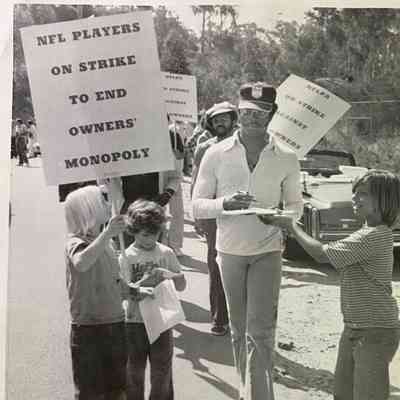
Jim Hill press photo
Before Jim Hill’s 50+ year career in sports journalism, he played professional football in the NFL. In this historic AP wire photo that is part of the collection “Defensive back Jim Hill of the Green Bay Packers signs autographs outside San Diego Chargers’ Training camp, first to be hit by strike of National Football League Players Association. A few boys helped carry picket signs Wednesday in gratitude.”
The original press photo is dated 7/3/1974.
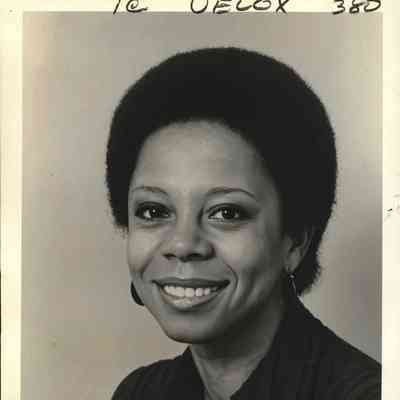
Melba Tolliver press photo and signed “Accidental Anchorwoman”
Melba Tolliver was the first black American to anchor a network news program. The journey to the anchor desk was not easy; she faced conflict by just trying to be herself.
Melba Tolliver, as quoted in the New York Times, 2/18/1973:
“The day before I was supposed to cover Tricia Nixon’s wedding at the White House, I got my hair changed to a natural—previously, I’d been having it straightened—and can you believe they actually told me I couldn’t appear live in the studio unless I changed my hair back to the way it used to look? They said I looked less attractive—less feminine. But it was their standard of femininity, not mine.”
She refused to straighten her hair and she was told she could not sit in the studio behind the long table (with others) to do a wrap‐up of the weekend wedding. “They didn’t want me to appear on the tape either,” Melba recalls, “but it couldn’t be avoided. I wasn’t about to go back to straightening my hair…” (New York Times)
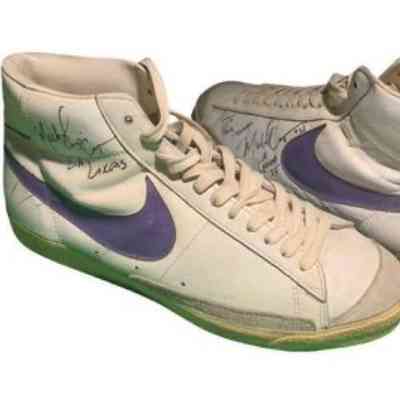
Michael Cooper, basketball HOF and TV analyst
The saying goes: “Don’t meet your heroes; you’ll only be disappointed.” That wasn’t the case with Michael Cooper three decades ago in the basement of a church in Pasadena.
Cooper would go on to have his Lakers jersey retired and become a member of the Naismith Hall of Fame, but that night at a church in Pasadena, he was a concerned community member more so than a former defensive player of the year who Larry Bird said was the best defensive player that ever guarded him.
That night, I learned that Cooper was appearing at the church. At the time, I worked nearby and brought a stack of anti-gang posters I had designed. Cooper signed each poster and they were given to young people during his appearance.
Cooper and his Showtime teammates had an effect on me growing up. By far the best example was when they won the 1985 championship against their nemesis, the Boston Celtics—and Larry Bird. The Lakers had never beaten the Celtics in a championship series—losing eight times—and the Lakers were blown away by 34 points at the Boston Garden in game 1 of that series. The Lakers were thoroughly embarrassed and written off for dead.
They didn’t give up and won four of the next five games, and defeated Boston 4–2, capturing the championship at the Boston Garden, the very same floor they had been run off just days earlier.
In times of trial, I think back to that series and remind myself that only I can extinguish hope by quitting before a positive history is written no matter how bleak the past has been.
Years later, a pair of Cooper’s game-worn and signed shoes from that historic 1985 championship season came available and I quickly bought them. In these shoes, Cooper guarded Larry Bird, Michael Jordan and more.
It’s impossible to say for sure, but I like to think that those simplistic anti-gang posters that Cooper signed years ago helped guard and inspire those kids in a Pasadena church.
Cooper would go on to become a successful TV analyst after his playing days.
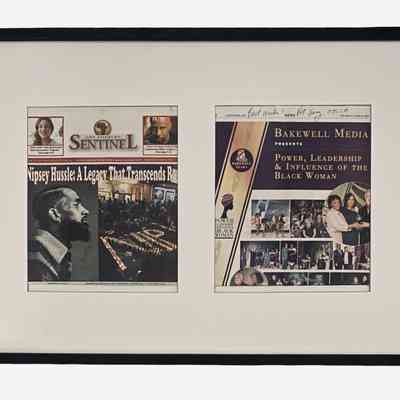
Nipsey Hussle, Pat Harvey LA Sentinel Newspaper
Pat Harvey and Nipsey Hussle each reported about L.A. in their own way. Harvey has enjoyed a successful career as a news anchor at CBS Los Angeles since 1989. Hussle was born a few years earlier and went on to paint vibrant and graphic L.A. street stories using rap lyrics before he was murdered in 2019.
The two had at least one in-person meet up: a 2019 interview, six weeks before Hussle was killed. The interview was short, but revealing. The 33-year-old rapper, who was no stranger to cursing on his records, addressed Harvey as “ma’am.” The respect seemed mutual. When Harvey asked Hussle about his troubles with the law, it served to shed light on his story and was not used as a gotcha moment.
When talent from different generations like Harvey and Hussle can come together and talk openly, there is hope—even amongst his death, the interview can serve as a template for others.
If only there had more time.
Video link to the CBS News Los Angeles interview: https://www.youtube.com/watch?v=K9gD0iW4nd0 Produced by Gerri Constant.
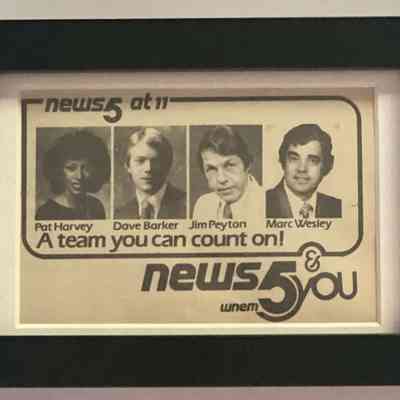
Pat Harvey
Before the journalism accolades, community service recognition and respect that Pat Harvey built up over nearly 40 years as a news anchor at CBS News Los Angeles, she began her news journey at WNEMTV5 News in 1979 in Michigan.
Since arriving in Los Angeles in 1989, she has never left CBS Los Angeles or the communities she serves; she still appears on-air nightly; and has gone on to become the longest-running news anchor in prime time at one station in Los Angeles history (36 years and counting), a feat that may never be duplicated.
The vintage piece is an original 1981 print advertisement, featuring Pat Harvey in the first anchor position of her career. The other two images are original advertisements from her early days at KCAL TV 9, now known as CBS Los Angeles.
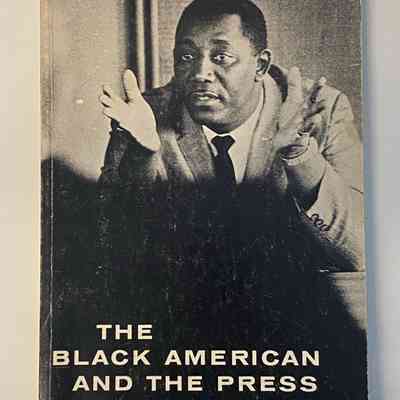
THE BLACK AMERICAN AND THE PRESS
From the back cover: A hard-hitting, oft times critical but essentially constructive examination of the effect of coverage by the news media on the so-called Negro rebellion which brings to light some important aspects of the responsibility of the press in crisis reporting.
The views expressed in this book were originally aired during a four-part symposium held at the University of California at Los Angeles, sponsored by the Department of Journalism.
Participants included eminent sociologists, historians, authors, newspaper-men, journalists, foreign correspondents and important Negro leaders.
They explored such vital questions as:
Does the presence of TV cameras trigger responses which might otherwise have remained latent?
Should the newspapers alert the public to festering conditions before they erupt?
Does crisis reporting inevitably lead to sensational reporting?
How should news of the city’s racial problems be handled?
What can be done to develop a rapport between the Negro community and the press?
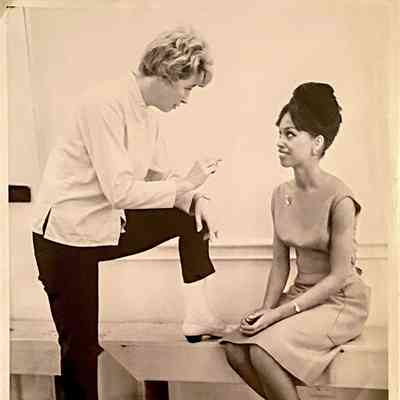
UPI image of “first time Negro dancer…”
From the back of the UPI image: “NEW YORK: Choreographer June Taylor (left) chats with Negro dancer Mercedes Ellington here September 13th, after the 24-year-old New Yorker was chosen as one of the 16 members of the dance group who will appear weekly in the Jackie Gleason television show. It marks the first time a Negro dancer has been selected to appear on a weekly television program.”
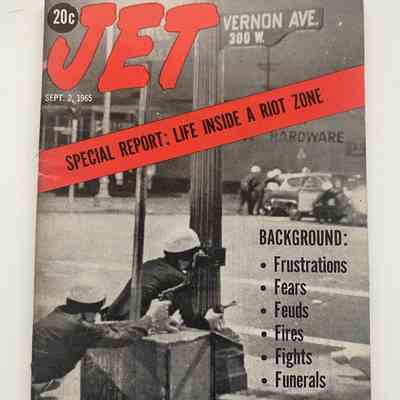
Vintage 1965 Jet Magazine
OriginalMagazines.com describes this issue:
The September 2, 1965 cover remains one of Jet’s most iconic images precisely because it refused aesthetic distance. The composition—police in combat stance, weapons ready, on an American street—visually argued that urban Black neighborhoods had become occupied territory.
This was intentional editorializing through photography. Jet didn’t explain that America was treating its citizens like enemy combatants. It showed it.
The six-word cascade—Frustrations. Fears. Feuds. Fires. Fights. Funerals—worked as both table of contents and thesis statement. Each word represented a section of the coverage, but together they formed a narrative arc: from underlying conditions to violent expression to human cost.
The September 2, 1965 issue of Jet Magazine is more than vintage ephemera. It’s a primary source on a turning point in American history—the week the civil rights movement’s narrative of progress collided with the reality of urban despair. For anyone serious about understanding the 1960s, racial politics, or the power of the black press, this issue isn’t optional. It’s foundational.
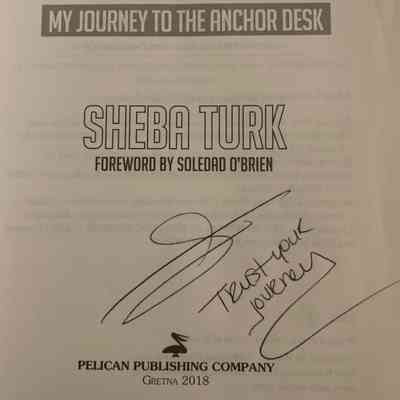
“Off Air: My Journey to the Anchor Desk” signed, Sheba Turk
CBS Los Angeles morning news anchor Sheba Turk is one of the most recognizable news personalities in Los Angeles based upon total number of social media followers; she is currently only behind well-established Los Angeles news personalities, some of whom had—and still enjoy—national presences. Being so popular in Los Angeles, the second largest DMA in the country, is noteworthy, as Turk has only been in Los Angeles since 2023 after being a veteran reporter and anchor in her hometown New Orleans at WWL-TV. Social media comments from her New Orleans followers since she relocated to Los Angeles are overwhelmingly positive and in support of a local daughter making good in the next chapters of her journey.
Turk’s relatability carried over to Los Angeles audiences and she was quickly promoted to a weekday morning news anchor position at CBS Los Angeles.
She often cites her legendary teammate at CBS Los Angeles, Pat Harvey, as a close friend and mentor. Turk herself has mentored young women interested in the news industry, ensuring that future news professionals continue to be developed who can one day become mentors and role models themselves.
“Off Air” is her first published book. The signed copy shown here is fitting—it is a former New Orleans library book.